Insights · Liquor sampling marketing
Why Sampling Is the #1 Lever for New Liquor Adoption
When a brand wants to know what actually moves a new spirit off the shelf, the answer is consistent and a little unglamorous: get the liquid in someone's mouth. Roughly 90%+ of new-spirit adoption starts with an introduction or sampling (The Kat Agency), and 81% of shoppers approach a display because of a free sample (EventTrack, 2015).
By Juan José Mesa7 min read
The data: trial beats advertising for new spirits
Every new spirit enters the market with the same handicap: nobody has tasted it. The shelf it lands on already carries hundreds of labels the shopper recognizes, and recognition wins ties. Advertising can build awareness over quarters; a sample builds preference in about thirty seconds, because taste is the one product attribute a spirit brand cannot communicate any other way.
The numbers behind that intuition are unusually consistent. Roughly 90%+ of new-spirit adoption begins with an introduction or sampling (The Kat Agency). And the pull starts before the first pour: 81% of shoppers say they approach a display because of a free sample (EventTrack, 2015). Sampling is not one tactic on a list. For a liquid product with no trial history, it is the adoption mechanism itself.
Trial removes the only risk that matters
Picture the shopper in front of the tequila shelf. The bottle they know costs $32. Yours—better liquid, better story—costs $38, and they have never heard of it. The barrier is not price; it is risk. Nobody wants to be stuck with a bottle they do not like, so the default brand wins by default.
A sample removes that risk entirely. But where the trial happens changes what it produces:
Off-premise
Immediate purchase
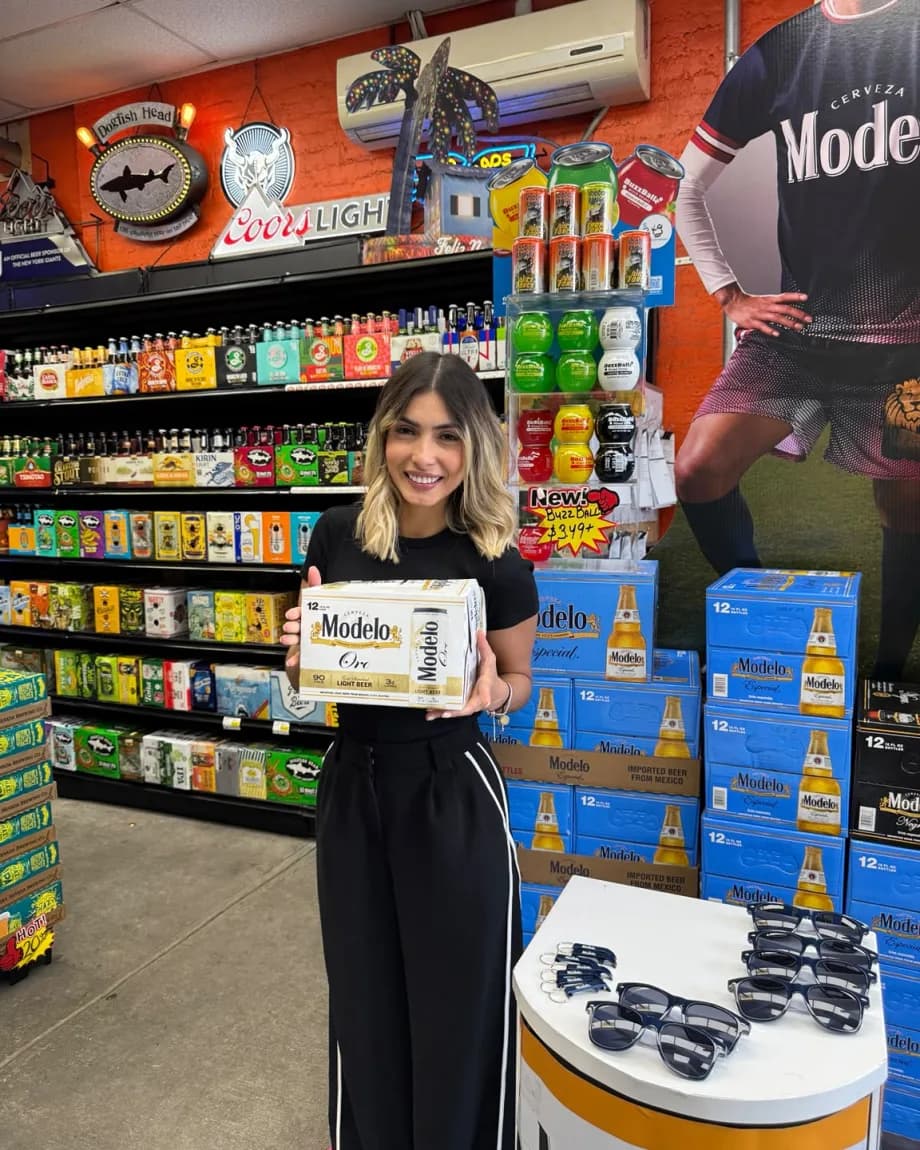
In a liquor store or grocery aisle, the distance between the taste and the transaction is a few steps. The shopper likes the pour, the ambassador points to the shelf, and the bottle goes into the cart—same visit, same receipt. Off-premise sampling is the closest thing this industry has to a direct-response channel, which is why it is measured in bottles sold during the demo window.
On-premise
Context and memory
A bar or nightclub sells no bottles off a shelf; it sells the serve. The right pour in the right moment—the music, the crowd, a bartender who vouches for it—turns trial into memory. The payoff arrives later, as call-outs by name and re-orders that build the velocity story distributors actually look at.
Both move adoption. They simply move it on different clocks, and a serious program measures them differently instead of forcing one metric onto both.
The psychology of priming
Underneath the conversion math sits a second effect. A guided taste is a small social exchange: a person offers you something, talks you through it, answers your questions. That exchange primes the brand long after the cup is empty—and the industry's own research puts a number on it.
“91% of customers confirmed they would feel more optimistic about a brand's product or service after actively participating in a brand activation or experience.”
The operative word is actively. A shelf talker is passive; a banner ad is passive. A two-minute conversation about what you are tasting, where it comes from, and what to mix it with is active participation—and it keeps working even on the shoppers who do not buy that day. They walk away with the memory of a brand behaving generously, which is exactly the state of mind a second touchpoint converts.
How to measure it (so it is not a cost center)
Sampling keeps its budget only when it is run like a sales channel and reported like one. Four numbers turn a tasting from anecdote into audit:
Samples poured
The raw denominator. Counted pour by pour, not estimated from the cups missing at the end of the shift—every downstream metric inherits this number's honesty.
Conversion to purchase
Bottles sold during the demo window divided by samples poured. This is the line that turns a great event into a P&L argument, and it tells you which stores, days, and scripts to repeat.
Cost per sample
Staff, product, and materials, fully loaded. Industry benchmarks run roughly $0.50–$5.00 per sample depending on the spirit and the format—know where your program lands before you book the next round of dates.
Manager-verified bottle counts
Shelf counts at the start and end of the shift, signed off by the store manager. A sales-lift claim is only as strong as its verification, and a signature beats a recollection.
The Hispanic-market angle
Now place that machinery inside the U.S. Hispanic market and the lever gets longer. Preferences here are stronger and more specific: 85% of Hispanic consumers prefer Mexican beer versus 70% of the general market, and they spend $26.30 per spirits occasion versus $16.70 (Technomic, 2013—a historic study, but the directional gap is the point).
Strong preference is earned through trust, and trust is in-culture. A bilingual promotora who moves naturally between Spanish and English—who knows whether the bottle is headed for a quinceañera or a Sunday carne asada—is not delivering a script; she is giving a recommendation from inside the culture. That is the difference between sampling that feels like advertising and sampling that feels like advice, and it is why bilingual staffing is not a nice-to-have in this market. It is the multiplier on every metric above.
None of this is glamorous, and that is rather the point. New-spirit adoption is not won in a deck; it is won in a thirty-second exchange at a folding table, repeated and measured until the velocity shows up. Get the liquid in someone's mouth, count what happens next, and let the data book the next shift.